Time at Home


Ways to Contact Me

  • Skype: kalzebeta
  • Yahoo Messenger: kalzebeta

Yoga Party!

Yoga Party!
Check this out!

Blog Archive

Showing posts with label arabic language. Show all posts

Wednesday, June 20, 2007

40 Minutes on the Phone

I called Malek and talked to him for 40 minutes. I think that will probably cost a million dollars. It was worth every second, though. Bringing these two strange worlds together again. I have not been gone for long, but it feels like centuries, millenia. "With you, everything is life or death," says Trevor. Yeah well...that's...not ALWAYS totally true...

Tonight I watched about 50 trailers and previews on the apple website. I was impressed, except for the part where it got to movies about Islamic Extremists and Terrorism. Whatever, freedom of speech, "horea ta'abeer erra2ee", if people want to make movies about Islamic Extremists who strap bombs to themselves, or conspire to strap bombs to themselves, or who believe that the only point in life is to engage in Holy Jihad, go them. It's a free country. Doesn't mean I have to frequent them, but they can do whatever they want.

I just get mad when entwined in the images of terrorists are images of people praying in mosques, or flashes of pages from the Quoran. Seriously. As a Mormon, I imagine I'd feel the same kind of frustration if I were to see a trailer for a movie about the Fundamendalist Church of Jesus Christ of Latter-day Saints, with images of polygamist colonies flashing next to images of the Book of Mormon.

About two years ago, I came to the realization that the world would be so much better if everybody would just stop being stupid. "People should just stop doing stupid things. If everybody just didn't do dumb things anymore, the world would be such a better place!" The difference is that I don't think the government has the right to control people doing stupid things, like make images that diliberately distort the western world's perception of Islam, and perpetuate the image that it is a fundamentalist terrorist machine.

My Jordanian friends all said that the US government is controlled by Jews. That our media is controlled by Jews. That the Jewish influence in our society is only superceded by Israel itself. I never thought that was true, until coming home. You notice things like kosher signs on food labels, and the star of David, a lot more after being without. Hmmm.

Reading, "The Lemon Tree," was a great relief for me. It helped in so many ways. I finally felt as though there were someone who understood part of my experience, though what I lived in Jordan was in many ways very far removed from the Arab-Israeli-Palestinian conflict, and that was the heart of the book's story. I need to contact the man who wrote it; he did a most excellent job.

I strongly believe that the solution to the misunderstandings, the solution to violence, the solution to hate - is education, compassion, and understanding. You get education from reading. You get compassion from experience. You get understanding from exposure. All of these things, reading, experience, and exposure - the base of it all - is language.

The Arabic Language is the first step.

Saturday, May 5, 2007

Sooq

Today was the happiest day of my entire time in Jordan so far.

I woke up happy. A few months ago, the noise in the morning really used to bother me. My arabic family yells a lot. I didn't understand what they were saying before, and mostly, I didn't understand the tone of things.

This morning, their noise was actually calming. One of my favorite things about home in the states is waking up on a Saturday morning to the sound of clinking dishes downstairs. Familiar delicious smells creeping in, like bacon and eggs, and pancakes...this morning, it was a similar experience. Familiar smells, familiar noises - calming. I understood what they were saying, it didn't make me want to cry and curl up - the opposite! Amazing.

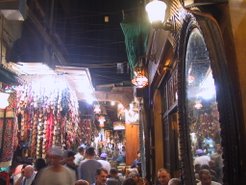
Then, I went to the sooq with Mona, my arab mom, and Mahmoud. It was the most fun shopping experience I have ever had in my life. This place, it is so beautiful. Imagine lots of people in the streets, open stores, people yelling things like, "bazalla bazalla bazalla lira wa noos lira wa noos!" - "beans beans beans, two bucks, two bucks!" Oranges in their bags hanging down from the roofs of stores, piles of dishes, and shoes - storefronts, people walking, people selling.

In order to buy or sell or eat or LIVE here, you have to speak Arabic. I can't pretend to speak fluently, but I definitely understand. I don't even think I can say I understand fluently - Arabic is so large and vast and huge. But of Irbidean Ammiya Arabic, I understand about 75% of the words, and 95% of what's going on.

I was so happy today. I can't exactly explain why. Just knowing that I am a daughter of God, and knowing that I am going to use my Arabic. I think God has been helping me recently, giving me extra measures of patience and wisdom. When bad thoughts come to my head, and I feel discouraged, I chase them out with hymns. It's not worth focusing on the bad.

I bought presents for my family today. Heaven knows how I will bring back all of this stuff in one suitcase, with the 65 kilo limit. Allah ya'alim!

I love Jordan. Jordan first.

Tuesday, April 17, 2007

Dead Sea

I went to the Dead Sea. It was incredible. The water has special healing properties - not just the water, but the mud. I don't really understand why, but for centuries it's helped people with all kinds of skin disorder.

It may be partly because the dead sea is at the lowest point on earth, or maybe because it's saltier than the Salt Lake, or a combination of factors, but you float.

I mean, you REALLY float.

You just lay back and voila, you're on your back, floating. No effort. In fact, when you try to go down, you can't. You can't swim. It's the weirdest thing ever.

A single drop of the water got into my eye and screamed, "F@CK F*CK F%CK F&CK F#CK!!!" Marie-Amelie pulled me out of the water, and got me my towel, thankfully. I felt like my eye was gushing blood. One tiny single drop.

I went to the Dead Sea with the group of French students from the University of Marseilles. Besides Malek, they are my best friends at the University. They leave next week, which is sad.

We stayed up talking, singing, and swimming (brrrr) until 4:30 in the morning last night.

I took a real shower.

My brain is tired from changing languages on command. It's hard to think in Arabic, French, and English at the same time. Nobody speaks English as their mother language. Mooshkila.

One of the neatest experiences for me since being here was in Ayhem's hotel room. He organized and carried out the trip. He invited us all for a drink (yes alcohol, and no I didn't drink, and no they didn't get drunk, and no, they didn't pressure me to drink, and yes I went because I felt like being sociable), so we were all hanging out there in the hotel room, and somebody said something that triggered my thoughts to the song, "You Aint Nothin' but a Hound-dog!" so I started singing...

One of Ayhem's many cousins who was with us said, "Oh, I know who that is. It's John Travolta."

"What? ARE YOU FREAKING CRAZY? That's Elvis Freaking Presley!"

"No no, I seed movie once, was with John Travolta and Olivia Newton-John! I sure this song is him!"

"Okay, I know that you know a lot about my culture, and I'm not saying you're stupid, but that song is DEFINITELY by Elvis Presley."

The French kids were laughing hysterically, all (of course) taking my side.

"Okay okay okay maybe you right, but you ever see Grease?"

"Of course!" - and I erupted into, "Summer lovin', happened so faaast..."

Alex, one of the French students, started singing the guy's part, and some of the other girls did background vocals. It was like something exploded. We started singing song after song.

Eventually, the Arabs were like, "Sing something in Arabic!" I burst into a chorus of (what is probably the most annoying Arabic pop song ever) "Ya Tab Tab, wa dela'aaa..." followed by, "ba7bk, ana kateer, ya habebe dela'aa tela'alaaaaaay." The Arabs with us (Ayhem and two of his cousins) sang along, all of us in hysterics.

The French students don't speak Arabic. After we finished that, I started singing, "Quand il me prend dans ses bras, il me parle tout bas, je vois la vie en roooose..." and EVERY single one of them sang along.

It was a big deal for me, sitting there. I was the only one in the room that understood everything going on, who could share in every single part of what was happening. I have a really special gift. I should not underestimate the power or importance of my language skills.

I made a vow to myself that I will use them in my life.

Friday, March 30, 2007

Whoah this week went fast

This week marks the exact halfway mark for my travels abroad.

Many, many, many things have happened in the past few days. I looked at the date of my last blog post and was shocked to see it was almost a WEEK ago!! Wow.

Here's the latest with Hibba's stalker - he's in the hospital in Malt, because he loves her so much she's made him totally sick. And "Inti illi wa BAS!" has become a family joke. (you belong to ONLY ME! - one of his weird text message). He called her over fifty times the day before yesterday, but yesterday he suddenly stopped. What a creep.

I'm making some really great friends in the International club. Jihad is an Arab-Israeli (the word for that in Arabic is arab-tamanya-we-arba'aeen), Wadat is the president of the international student club, she's Algerian, not Moroccan...we speak French together. And of course, there's Malik, probably my best friend here besides my Arab sisters.

Malik taught me how to play backgammon. Writing that sentence in English...it seems juvenile. Let me tell you though, backgammon is really fun. He has a really hard time pronouncing "Massachusetts". I have a really hard time pronouncing the Arabic word for "foam" - rghwa. He quizzes me on my leaders of Middle Eastern Countries. I think he'd kick my trash in the capitals game, although probably not if it included capitals of the United States.

Malik and I talk about interesting stuff. Like his opinions on the summit that is going on right now with the Arab league, which is extremely corrupt - why Syrian Economics are screwed up, why Americans have such a negative concept of Arabs, our various states of coming in and out of culture shock (remember, even though he lives about an hour away, he's from a completely different country, and Bashar Assad is a totally different kind of leader from King Abdullah II).

My Arabic! I sometimes get frustrated, but its kind of pointless to sit around lamenting the fact that I can't speak as well as I'd like to yet. So instead, I just speak - and end up doing okay. I would say I have more than doubled my vocabulary in the past month. I sometimes go for days without speaking any English, which is fun.

Last night, we went to the airport to welcome a group of French students coming from the University of Marseilles for a cultural-exchange program with Yarmouk. I had so much fun. The French students were SO cool. I love being able to speak French.

I'm looking forward to hanging out with them more.

MAKING FRIENDS, FINALLY!!!!!!!!!!!!!!

General Conference here...is gonna be interesting.

Sunday, March 18, 2007

Words are Important

I study words. Every day I hear hundreds of new words. Language is about words: subtle differences of meaning, connotations, power, intonation - words carry meaning. It's okay to understand the meaning of a word in generalities at first, but the actual specifics of the meaning of the word are important. Words are power.

"I don't understand why you used the word jihad in that sentence..."
"Oh! I didn't say jihad, I said jihat...you know, (english:) minimal pairs..."
[hearing a familiar linguistics term that I fully understand made me want to stand up on the table and shout for joy! But I didn't.]

Not only specificness in sounds, but in meaning. For example, today in Prof NagiH's class, we went over the difference between "bad" and "not good." We talked about euphamisms and "diplomacy" in words - as in, politically correctness. Specificness.

An obvious example is going to the bathroom. Every language has polite ways to express the need to go, and crude ways. It is important to know both so you can use them properly to get your point across. In English, you can say, "I need to go to the restroom." In Arabic, one equivalent of that is, "I need to go wash my hands." Interesting.

In Arabic, the political phrase for "American Government" is not hakooma amriki, it's idarat amriki, or "American Administration." In some contexts they are the same, but in others they have vastly different meanings: "the School Government" is usually a group of students elected by students to make decisions for students, whereas "the School Adminisitration" is usually a group of adults who are in charge of admissions, facilities, and employees of the school (etc).

I volunteered that the main difference between "government" and "administration" is the first is a word that describes something that does not change (even if there is a coup and your country goes from a Democratic government to a neo-theocratic-totalitarian-dictatorship government, it remains a government. I suppose the exception would be changing to anarchy - but even "governmentless" is a form of government, in a way. It is a description of the state of the government), while the second is something in a continual state of change.

I also ventured a guess towards the etymology of the word: the United States has the most political leverage in the world. It is powerful. When you describe an action taken by the United States, it is important to acknowledge that it is not necessarily the fact that it is a Democracy, or that we have the Constitution and the Bill of Rights etc. that makes the political decisions, but rather the people who were elected to power that are responsible for making them. "American Government" implies and connotes something altogether different from "American Administration."

"Impossible" and "unlikely"/"improbable" are worlds apart in meaning, and that difference is important to understand. You know?

Thursday, March 15, 2007

Omen

Amiyya is colloquial Arabic. FusHa is standard formal Arabic. The latter is used mostly in writing, the former in speaking. I understand/speak much better than I read/write.

"How can I learn FusHa?"
"Kate, first you've got to want it more than anything else, from within. Do you want to learn FusHa?"
"YES. I do! I need to! Then what do I do?"
"Then you have to read. Read, read, read. Read with Hibba. Read on your own. Read as much as you can. Learn the grammar, but you have to do it in a functional way. Reading will help you better and faster than anything else."
"Okay."

Prof NagiH's name comes from the same root as the verb "to succeed." I take that as an omen.

Thursday, March 8, 2007

Jerusalem Center People

The BYU Jerusalem Center organized a field trip to Jordan for their students. They arrived in Amman three days ago, and today is there last day.

I suppose it had something to do with honoring their long journey, or recognizing that they too are part of the Mormon minority in the Middle East - honestly, there didn't seem to be much purpose for the Al Husn Branch youth to make an activity out of going down to meet them.

Two weeks ago, I was counting down the days until I could see the 44 Americans. I ended up laughing, talking, and enjoying myself more with the Jordanians.

The best part of the trip (by far) was the ride to and from. President Dew had hired Omran again - he had driven us to Amman a week before on the Seminary Opening-Activity trip to the Royal Car Museum. Omran is 23, skinny, and somewhat shy. He's not the worst driver in Jordan, but both times I've gotten into his bus, I've thought about how I haven't written my will yet.

His "bus" isn't really a bus, but a van with ten seats. Because the engine is weak, and with ten people crammed inside the van is nearly twice as heavy, we would average around 10 mph uphill, and 90 mph downhill.

Omran got pulled over by the Public Police three times total, which involves a guy dressed in bright reflective gear waving a big stop sign-looking thing at your car from the side of the road.

He had gotten a ticket on the Seminary Opening Activity trip, but because he had connections w/ the police, he didn't end up paying.

This time, they wanted his license, and the licenses of two other people in the car. They asked us where we were going, where we were from. I don't think they stopped us because we were going too fast, in fact, I never figured out if there was a reason at all.

The final time he was stopped, the policeman asked him if the girls in the car were "passengers" or "family."
"Family."
"The right answer tonight was 'passengers' - get going!"
We all laughed, and turned the Amr Diab back up to its rock-concert volume.

I talked to Tamr and Majdee most of the ride. It was the second or third conversation I've had in Arabic where I haven't thought about "language." He told me some stories about a loch-ness type monster in a lake in Russia. I told him about the witch grave at Camp Moses, and made up a scary story that involved me and Cindy walking there at midnight under the full moon.

The topic of conversation changed to witches, magic, and "gin". The English word for "gin" has a weak connotation - "genie" makes me think of Robin Williams, "How 'bout LADI, do you smoke, mind if I do?"

"Gin" here is a powerful word. Everyone in the bus listened to people tell stories. Chilling, exciting - magic is real here.

Jordanians are expressive when they talk. They thrive on wit, word plays, and making people laugh. Jordanian culture is about language.

The Americans were boring. Will it be like that when I get home?

Last night, instead of falling asleep listening to American music, I listened to Arabic music.

Monday, March 5, 2007

Critique of Criticism

...ممكن اكتب شو e باللغة العربية

:المفردات اليوم

تحرَش جنسي
مناسبة
اسلوب
خصخصة

التحرَش جنسي هو مشكلة فيالاجتماعية العربية
المستوة التي موجودة فيها هي تناسب فيي
ما احب الاسلوب الكاتب
يكبر الخصخصة فالاردن


I would like to dedicate this blog post to anybody who has ever used the word "constructive criticism".

Criticism is a judgement derived from thorough observation. Sometimes criticism has a negative meaning: "He never notices the good things in me! He's so critical! I wish he would stop criticizing me because I'm doing the best I can!" Sometimes, criticism can be useful because it can spur change. "His critique of my short story was very helpful; if I can eliminate the passive voice, maybe the storyline will flow easier!" This is what we call "constructive criticism."

I remember the first time I learned the phrase, "constructive criticism." After my 6th grade teacher explained it, she proceeded to point out mistakes that the student had made. Since then, somewhere in my brain I have this connection between, "constructive criticism," and "I did something wrong."

Unfortunately - or fortunately? - I am a perfectionist. I wear concealer to cover my blemishes. I set a high bar for myself, and try to achieve it. As a freshman in high school I made a vow to (try to) never feel ashamed of myself again. Even though I make tons and tons and tons and tons of mistakes, I do not feel ashamed when I know I am doing my best. I pour my whole soul into this Arabic language. I have been blessed with an abnormal amount of tenacity, "stick-to-it-ive-ness." I am constantly critiquing my self, and telling myself what/where/how I can do and be my idea of better.

Criticism is useful when it can lead to positive change. I am infinitely more self-aware than others may think, but I do not claim to know all of my flaws. When Prof. NagiH corrects me, an inevitable occurance in an Arabic as a Second Language class, it's extremely helpful. I learn from correcting my mistakes, moving forward, working from the criticism that he gives me.

Why is Prof. NagiH's criticism more useful to me than, for example, somebody telling me that the pictures on my blog could be better, or that I could be a better writer? Several reasons:

Prof. NagiH is (duh) better than me at Arabic. I absolutely respect his criticism. I believe what he says, and value it.
A certain aforementioned person is not a better writer or photographer than me. His criticism is not from a base of deep knowledge about the subject, but rather his own - albeit informed - average opinion. I do value other people's opinions, but - sorry - I trust opinions of specialists in the designated field more.

[Ceci dit, I need to improve my both my writing and photography.]

Prof. NagiH does a lot of nodding and smiling - go to ANY foreign language class, and you will find that the more positive reinforcement, the more the teacher gives out aseenti-s, tamam-s and momtaz-es, the better the student-teacher relationship will be (not to mention class dynamic), and the more respect the student will have for the teacher's criticism. The main consequence of all this is real learning, and real motivation to continue learning.

Fortunately for linguists and their profession, the subtleties of language are ENDLESS. Words are not the only tool used in communication - and one thing linguists do is define the layers of meaning behind the words.

I am sensitive to these layers.

Prof. NagiH does not think we are stupid. His criticism is to help us learn. It's his job to criticize us. Friends criticizing friends leads me to ask, "why is it important for them to criticize me? What do they want out of it? Is there some hidden implication in what they are trying to tell me?"

For example:
"Kate, your laugh is really loud."

The sentence isn't necessarily just an evaluation of the volume of my laughter. Depending on tone, context, and stress of words, it could mean lots of things.

"Your laugh is really loud and I wish you would shut up."
"Kate, I've told you a million times how loud your laugh is. Do I seriously have to tell you again?"
"Congratulations, Kate, you won the contest for World's Loudest Laugh."
"No, no, I didn't mean your laugh was quiet! It is really loud!"

"You could take better pictures," could mean:

"I expect better from you because you are intelligent and capable!"
"I'm disappointed because I know you aren't doing your best."
"You should be doing better."
"Your pictures suck and I hate them all."
"You should just give up now."

Expressing criticism in a clear and direct way minimizes dangerous misinterpretations/miscommunications.

Language learning is hard. Daunting. Like a mountain. Especially Arabic - you can't fudge your way like French, and, at least for native English speakers, grammatical structures are not second-nature.

Learning a language requires you to recognize both your mistakes and your successes. It's scary to learn that the little lines and circles above the word can change the ENTIRE meaning (ex: from passive to active: "The book was written by Kate." "Kate wrote the book." In arabic, the only difference is the vowelling), and to realize that I haven't EVER payed much attention to them.

If I were to focus all my thoughts on all of the things I don't know about Arabic, I'd be on the next plane out of this country. It would be too difficult. Even I, Kate Vasicek, "Stick-To-It-Like-Super-Glue" fifth-grade motto girl, would give up. People like Prof. NagiH with his infinite patience make this place for me. The "Wow! She speaks Arabic really well!" statements keep me confident, and able to pick myself each time I make a mistake.

I love this language, and I'm going to conquer it. I love the complexities of ammiya (spoken Arabic) and the depth of meaning found in fusHa (written Arabic). I am confident of my ability to learn both, and I will continue to strive to learn.

SUMMARY:
Telling me that I suck motivates me to figure out why you would say so, not how I can change to be better.
Telling me that I am capable of better will not motivate me unless I respect you.
Focusing on my flaws without any acknowledgement of my accomplishments lessens my respect for you.
Arabic is really hard, but a mixture of positive and critical feedback helps me learn.

It would be interesting to analyze the difference between "to critique" and "to criticize" - both denotations and connotations.

Sunday, March 4, 2007

Arabic Grammar is Hard

3.4.07

Today is the day that I started to pay attention to Arabic vowels, and verb forms.

In Arabic 201, I remember hearing these specific words, “Don’t worry about learning the verb forms right now.” So I didn’t, and it didn’t matter.

Now, it matters.

I wonder what it would be like to teach English as a Second Language. Would I die of boredom? Seriously, how do our teachers not want to kill themselves – the monotony of the job, the repetition, how little we understand…seriously. These teachers of mine have seemingly endless patience. They remind me of my High School mentors, Mr. Luikart and Mr. Hing – they inspire learning, they listen to us, they are extremely skilled and knowledgeable in their subjects…knowing Arabic is one thing, but knowing how to teach it to foreigners is another. I love my class dynamic. It’s so nice to be in a class where there is no communal language besides Arabic. It provides true immersion. I also love how we represent different parts of the world, and political, economic, and cultural topics always seem to come up.

Before knowing Nagihan and Aicha, the only thing that I knew about Turkey was from a documentary about Noah’s Ark that we used to watch as kids. Eye-witnesses accounts of sightings of the Ark on Mount Ararat (located on the border of Turkey) filled me with intrigue and wonder. I have always wanted to go there, climb that mountain, and see the ark with my own eyes. I totally believe it exists. In the documentary, there was this old guy that spoke in very slow, broken English, about his experience discovering the ark. His story always made me cry, even as an eight year old. Weird, remembering that.

I just helped Hibba with her English homework. She’s been writing her name “Heba.” I told her that “Hibba” looks a lot prettier. She decided to change it. There really aren’t rules for transliteration.

I don’t think I’ve ever studied past perfect and past continuous in English, but from my experience learning it in French, Arabic, and ASL, I was able to give Hibba a clear explanation in spite of my limited vocabulary.

Hibba has had a toothache for a long time. We went to the dentist after school. I was really worried about the quality of the dentist from how dirty the stairway to his office was (trash, cigarette stubs, dirt…nasty). I was pleasantly surprised to find the inside super spick and span, CLEAN. Rare thing in this place.

Adam and I talked a little bit about this. I told him that the Jordanian government could create hundreds and thousands of jobs by subsidizing pollution control or trash collection programs. He basically said that it wouldn’t work in this culture because this is a culture of “honor.” Picking up trash is not an honorable job. It’s humiliating. Think China, ‘Memoirs of a Geisha’, or ‘Mulan’.

In fact, the Arabic word for honor, sheref, in certain contexts can be more powerful than the F word in English. You can say, bishereffi! – On my Honor! But don’t you dare mention his honor, or her honor, especially in a negative way.

I know that it’s better for language acquisition purposes to not translate languages directly. However, for me, I’ve found that if I don’t try to attach English words to powerful words, like swears, I may end up embarrassing myself. It’s important for me to keep a word with similar power connected to it.

The F word is not strong enough for some usages of the word sheref. It took a while, but I finally found a stronger word, with the help of a friend.

Since I’ve left home, I’ve prayed and read my scriptures every day. However, only in the last week have I prayed before I go to sleep AND right when I wake up. It’s made a huge difference in my life. I understand more in class and at home, and I am happier. I miss people and places back home less, and I live more in the moment. Life here rocks.

Last week went by super fast. Insha’allah, it will continue this way!

Monday, February 26, 2007

Language Learning is a Bicycle

2.24.07

I was once told by a dear friend that I should write a book on language acquisition. I’m not really sure what it means to be a “goal-oriented” person; if it means that the action of forming a goal is enough motivation/incentive to drive its completion, I am definitely not “goal-oriented.” The goal is nothing special itself; the idea of it, the interest in it, the knowledge it apports me…I am a child of the 18th Century, le Siecle de Lumiere. Were it not for my allergies, you could classify me as “feline,” – insatiable curiosity. I am interest-driven. My list of goals is a towering sky-scraper next to the doll-house of goals accomplished. (I feel like a snob saying this, but I want to point out that just because I have a lot of unfinished goals, and I haven’t finished one billionth of the goals that I have, doesn’t mean that I haven’t accomplished quite a few things in my 20 years of earth life.) The friend who told me I need to write a book on language acquisition probably did so because he is information-driven. It is possible that someday my N.Y. Times Best Seller “The Art of Learning a Foreign Language,” (two birds with one stone!) – will fall into his hands, and we’ll both enjoy the euphoria of basking in our personal motivation-system.

“First, I want you to read the article, get the general gist of it, and then we’ll go over the vocabulary questions. Wadi3?”

I totally agreed with Professor NajiH, but since language acquisition interests me, I put on my well-worn journalist cap, and asked, “Why?”

“What do you mean?”

“I mean, why is it more important for us to read the whole article without caring about the individual words? What makes doing it that way better?”

“Kate! Kate, Kate, Kate. It is DEFINITELY better to learn languages this way. In my experience teaching students a foreign language, I have found that you will get more out of reading if you try to understand what’s going on in a general way first, and then dissect the individual words. The article is like an ocean, or a lake, and the words themselves are fish. First, you take your boat out onto the water, you sail to a good spot, and then you reel in the fish. You can gut them, cook them, and eat them…”

Prof NagiH said this with such passion and sincerity; that alone would have made me crack up, but because my information-driven friend and I had already used the ocean-fish metaphor in previous conversations, it took a lot of self control to not go into hysterics.

I came nearly halfway around the world to learn Arabic. I started with three goals:
1. Live with an Arab family
2. Take Arabic classes in Yarmouk’s language center

3. Work for an NGO

I have been here for a little over two weeks, and learned hundreds (literally) of words from living with the Hammouri’s, or I should rather say, from being bint Hammouri il-xhamees (they call me their “fifth daughter”).

I didn’t expect the language center to be that good, but it turns out that I have the best Arabic professor in the world. Professor NajiH’s teaching style seems to have been fine-tuned in the pre-existence to compliment my language learning style. He is expressive, funny, uses hand motions, does not belittle or make fun of mistakes (which doesn’t mean he doesn’t laugh if something turns out to be a funny mistake), makes sure that everybody in the class is clear on what’s going on while at the same time not letting the class’s pace slow down to a snail-tread. Professor NajiH is my hero.

I have an unfair advantage, English being my mother-tongue. If the Turks look confused, Prof NajiH will give a synonym and at least one of them (usually all) will get it (I don’t know where they got their enormous Arabic vocabularies, but I would willingly pay double at the same store in a heartbeat!), and explain it to the others in Turkish. If either I, or the Spaniard, don’t get it, he will first give a synonym, and upon seeing our blank faces, a synonym in English. Happily, English and Spanish have worlds of cognates, but translation strips words of their power. I love speaking English.

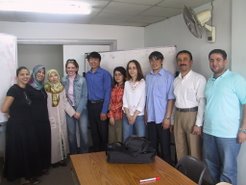
How rude, I don’t think I’ve introduced you; my classmates here are Nagihan, Jihad, and Aischa from Turkey (all from different cities, one from Istanbul, the others from cities whose names I’ve seen on a map maybe once in my life), and Omar is from Spain. I am from “America”.

Side note: I think it’s interesting how Arabs rarely say, “The United States of America,” and never say, “the States” – unless they’ve been there. The most common word for my country is, “America.” I am amrikia (GoH!!! – “original!”). “Where are you from?” “I’m from America.” Even typing it in English is funny to me – just slightly off. I would never say that. The word ‘America’ by itself is for July 4th and Fireworks and Apple Pie and Flag bumper-stickers. Don’t you think?

I have done a lot of thinking about how I learn languages. First of all, because I am interest-driven, languages automatically attract me. There is motion, movement, change – when you learn physics, you are stuck in a box. When you learn a language, you explore hundreds of new boxes. I could learn physics in Arabic, for example. (Yeah, if I were completely out of my MIND…last time I learned anything about physics was in 8th Grade Science with Ms. Newton!).

Not only do I have the unfair advantage of English, but I also have a limitless interest in language-acquisition. Arabic fascinates me.

I like to give myself many difficult and challenging goals, hoping that I will attain a handful of them, attacking it with the attitude of, “You should be able to do them all,” but then when I don’t, instead of self-mutilation, I just make more goals. For example, some of my current language goals are:
Do all the homework
Write down how many hours I spoke Arabic
Write at least 10 new vocab words I learned each day
Write a conversation I had
Write a journal-type entry in Arabic daily
Watch al-Jazeera in English and Arabic
Read 1 news Article in Arabic daily
Read the Book of Mormon out loud daily
Go over the class notes with someone in the family daily
Do exercises from il-kitaab t3lm il 3rbee 2 every day

These types of goals change on a weekly basis. For example, I noticed that the goal to read a news article every day in Arabic was sort of stupid. I don’t really want to buy a newspaper for one article, and I can’t read it fast enough standing in the Tunnel il Jam3a waiting for Hibba to stop using the phone in the cell-phone store (more on that later). So instead I made a goal to underline every word I don’t understand from the homework reading, and circle the ones that seem more important, or that come up multiple times, and then learn them.

It’s such a personal process, language learning. I constantly have to evaluate my progress, effort, and goals. This process is energizing and filling. I drink it up. I love Arabic.

I think the process of language acquisition is like a bicycle. First, you have to get on it.

“Hey, I have 4 credits free – why don’t I take Arabic and see how I like it?”

You have to learn how to ride. That takes a long time. Some people fall down so often that they never really learn how to ride one, but if you start learning young, it is not terribly difficult. It takes balance, patience, and tough knees.

I feel like my experience with French taught me how to ride the bicycle. Just because French is a Red (did anybody else hear about France’s new socialist candidate for prime minister? Or see what she wore when she introduced her platform?) bike and Arabic is a Green-White-Red-and-Black bike doesn’t mean I use different muscles and motions to ride it.

The wheels are the interesting part: 3teefee (no English words come to my mind right now that express the meaning this one does in Arabic…it means something like feeling, heart, opposite of logic, sensing) feelings are like a bead on one of the wheel’s spokes. I am a feely person, but even if you aren’t, you still have a bead on your spoke. Feelings are always involved no matter where Myers-Briggs puts you. My bead is very very very very big.

It’s like this. You get on the bike, you grasp the handlebars, you push off from the ground, and start to peddle. Your peddling is the amount of work you do – learning vocabulary words, doing the homework, speaking x amount of hours etc. When you peddle a bike, and you’re balanced, the bike is going to move. When you work, and you work the right way for you, you will learn the language.

Your feelings are directly related to the language-learning process. Sometimes you will feel extremely intelligent and good about yourself and your ability to conquer the language. Sometimes, the amount of vocabulary that you lack will be so depressing that you may wonder why you even got on the bike in the first place. The beads go around and around, up and down. Your emotions will do this, too, as you learn a foreign language. They will be cyclical.

When I was very young, I remember staring at the beads on my brother’s bike. He would go around and around the caul-de-sac, and the orange bead would go up and down, up and down. If I had remembered more from Mrs. Newton’s class, I could describe the action with more specific vocabulary. Something to do with centrifugal force? I stared at that thing for hours. It was interesting to me how if my brother slowed down, the bead would fall down to the center of the spoke. If he sped up, it stayed closer towards the tire of his bike, and became a beautiful orange streak. However, the position of the bead didn’t seem to depend on his speed as much as his balance.

No matter what you do, the bead will be in motion; if you want an emotionally stable goal, language learning is not for you. The trick is to find a peddling pace and equilibrium that doesn’t jolt the bead up and down the spoke. Anybody can handle changing emotions (we are, after all, human beings!), but rapid jerks of mood swings can cause depression, self-pity, and feelings of failure.

I would definitely say that my language learning has been cyclical. In an email to my dad, I described how my feelings and emotions seem to be on a 24-hour cycle. I feel like if I have a fantastic day, the next one is almost definitely doomed to be miserable. “Never feel homesick again,” or “Never feel stupid again,” are dumb, unattainable goals. However, I do have goals like, “Make the space between attacks of homesickness longer,” and “When you feel stupid, control your negative voice.”

Despite its many challenges, riding the bike is worth it. I’m biking up the mountain of the Arabic language. Someday, I want to look down on the breathtaking biblical landscape and feel the shivers down my spine as I imagine the men and women who passed here before – the sun setting over the Al-Aqsa mosque…incredible.

*The bicycle has been equated to “language acquisition” several times in this post, however I would like to clarify what that entails. To me, Arabic is not translated English. It is the whole experience of being here, walking in the streets, reading the signs, not letting the Taxi driver overcharge me, learning to live in a culture that doesn’t believe in privacy, drinking water that I am not sure is healthy for me, using bathrooms that I am sure aren’t, facial expressions, proxemics, political ideas, the weather, the cost of living… ‘language’, to me, is not reserved for the dead philosophers who wrote great ideas way back when – it’s a living, breathing being. I’ll save that metaphor for later, though.