2.24.07
I was once told by a dear friend that I should write a book on language acquisition. I’m not really sure what it means to be a “goal-oriented” person; if it means that the action of forming a goal is enough motivation/incentive to drive its completion, I am definitely not “goal-oriented.” The goal is nothing special itself; the idea of it, the interest in it, the knowledge it apports me…I am a child of the 18th Century, le Siecle de Lumiere. Were it not for my allergies, you could classify me as “feline,” – insatiable curiosity. I am interest-driven. My list of goals is a towering sky-scraper next to the doll-house of goals accomplished. (I feel like a snob saying this, but I want to point out that just because I have a lot of unfinished goals, and I haven’t finished one billionth of the goals that I have, doesn’t mean that I haven’t accomplished quite a few things in my 20 years of earth life.) The friend who told me I need to write a book on language acquisition probably did so because he is information-driven. It is possible that someday my N.Y. Times Best Seller “The Art of Learning a Foreign Language,” (two birds with one stone!) – will fall into his hands, and we’ll both enjoy the euphoria of basking in our personal motivation-system.
“First, I want you to read the article, get the general gist of it, and then we’ll go over the vocabulary questions. Wadi3?”
I totally agreed with Professor NajiH, but since language acquisition interests me, I put on my well-worn journalist cap, and asked, “Why?”
“What do you mean?”
“I mean, why is it more important for us to read the whole article without caring about the individual words? What makes doing it that way better?”
“Kate! Kate, Kate, Kate. It is DEFINITELY better to learn languages this way. In my experience teaching students a foreign language, I have found that you will get more out of reading if you try to understand what’s going on in a general way first, and then dissect the individual words. The article is like an ocean, or a lake, and the words themselves are fish. First, you take your boat out onto the water, you sail to a good spot, and then you reel in the fish. You can gut them, cook them, and eat them…”
Prof NagiH said this with such passion and sincerity; that alone would have made me crack up, but because my information-driven friend and I had already used the ocean-fish metaphor in previous conversations, it took a lot of self control to not go into hysterics.
I came nearly halfway around the world to learn Arabic. I started with three goals:
1. Live with an Arab family
2. Take Arabic classes in Yarmouk’s language center
3. Work for an NGO
I have been here for a little over two weeks, and learned hundreds (literally) of words from living with the Hammouri’s, or I should rather say, from being bint Hammouri il-xhamees (they call me their “fifth daughter”).
I didn’t expect the language center to be that good, but it turns out that I have the best Arabic professor in the world. Professor NajiH’s teaching style seems to have been fine-tuned in the pre-existence to compliment my language learning style. He is expressive, funny, uses hand motions, does not belittle or make fun of mistakes (which doesn’t mean he doesn’t laugh if something turns out to be a funny mistake), makes sure that everybody in the class is clear on what’s going on while at the same time not letting the class’s pace slow down to a snail-tread. Professor NajiH is my hero.
I have an unfair advantage, English being my mother-tongue. If the Turks look confused, Prof NajiH will give a synonym and at least one of them (usually all) will get it (I don’t know where they got their enormous Arabic vocabularies, but I would willingly pay double at the same store in a heartbeat!), and explain it to the others in Turkish. If either I, or the Spaniard, don’t get it, he will first give a synonym, and upon seeing our blank faces, a synonym in English. Happily, English and Spanish have worlds of cognates, but translation strips words of their power. I love speaking English.
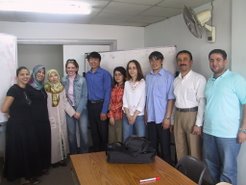
How rude, I don’t think I’ve introduced you; my classmates here are Nagihan, Jihad, and Aischa from Turkey (all from different cities, one from Istanbul, the others from cities whose names I’ve seen on a map maybe once in my life), and Omar is from Spain. I am from “America”.
Side note: I think it’s interesting how Arabs rarely say, “The United States of America,” and never say, “the States” – unless they’ve been there. The most common word for my country is, “America.” I am amrikia (GoH!!! – “original!”). “Where are you from?” “I’m from America.” Even typing it in English is funny to me – just slightly off. I would never say that. The word ‘America’ by itself is for July 4th and Fireworks and Apple Pie and Flag bumper-stickers. Don’t you think?
I have done a lot of thinking about how I learn languages. First of all, because I am interest-driven, languages automatically attract me. There is motion, movement, change – when you learn physics, you are stuck in a box. When you learn a language, you explore hundreds of new boxes. I could learn physics in Arabic, for example. (Yeah, if I were completely out of my MIND…last time I learned anything about physics was in 8th Grade Science with Ms. Newton!).
Not only do I have the unfair advantage of English, but I also have a limitless interest in language-acquisition. Arabic fascinates me.
I like to give myself many difficult and challenging goals, hoping that I will attain a handful of them, attacking it with the attitude of, “You should be able to do them all,” but then when I don’t, instead of self-mutilation, I just make more goals. For example, some of my current language goals are:
Do all the homework
Write down how many hours I spoke Arabic
Write at least 10 new vocab words I learned each day
Write a conversation I had
Write a journal-type entry in Arabic daily
Watch al-Jazeera in English and Arabic
Read 1 news Article in Arabic daily
Read the Book of Mormon out loud daily
Go over the class notes with someone in the family daily
Do exercises from il-kitaab t3lm il 3rbee 2 every day
These types of goals change on a weekly basis. For example, I noticed that the goal to read a news article every day in Arabic was sort of stupid. I don’t really want to buy a newspaper for one article, and I can’t read it fast enough standing in the Tunnel il Jam3a waiting for Hibba to stop using the phone in the cell-phone store (more on that later). So instead I made a goal to underline every word I don’t understand from the homework reading, and circle the ones that seem more important, or that come up multiple times, and then learn them.
It’s such a personal process, language learning. I constantly have to evaluate my progress, effort, and goals. This process is energizing and filling. I drink it up. I love Arabic.
I think the process of language acquisition is like a bicycle. First, you have to get on it.
“Hey, I have 4 credits free – why don’t I take Arabic and see how I like it?”
You have to learn how to ride. That takes a long time. Some people fall down so often that they never really learn how to ride one, but if you start learning young, it is not terribly difficult. It takes balance, patience, and tough knees.
I feel like my experience with French taught me how to ride the bicycle. Just because French is a Red (did anybody else hear about France’s new socialist candidate for prime minister? Or see what she wore when she introduced her platform?) bike and Arabic is a Green-White-Red-and-Black bike doesn’t mean I use different muscles and motions to ride it.
The wheels are the interesting part: 3teefee (no English words come to my mind right now that express the meaning this one does in Arabic…it means something like feeling, heart, opposite of logic, sensing) feelings are like a bead on one of the wheel’s spokes. I am a feely person, but even if you aren’t, you still have a bead on your spoke. Feelings are always involved no matter where Myers-Briggs puts you. My bead is very very very very big.
It’s like this. You get on the bike, you grasp the handlebars, you push off from the ground, and start to peddle. Your peddling is the amount of work you do – learning vocabulary words, doing the homework, speaking x amount of hours etc. When you peddle a bike, and you’re balanced, the bike is going to move. When you work, and you work the right way for you, you will learn the language.
Your feelings are directly related to the language-learning process. Sometimes you will feel extremely intelligent and good about yourself and your ability to conquer the language. Sometimes, the amount of vocabulary that you lack will be so depressing that you may wonder why you even got on the bike in the first place. The beads go around and around, up and down. Your emotions will do this, too, as you learn a foreign language. They will be cyclical.
When I was very young, I remember staring at the beads on my brother’s bike. He would go around and around the caul-de-sac, and the orange bead would go up and down, up and down. If I had remembered more from Mrs. Newton’s class, I could describe the action with more specific vocabulary. Something to do with centrifugal force? I stared at that thing for hours. It was interesting to me how if my brother slowed down, the bead would fall down to the center of the spoke. If he sped up, it stayed closer towards the tire of his bike, and became a beautiful orange streak. However, the position of the bead didn’t seem to depend on his speed as much as his balance.
No matter what you do, the bead will be in motion; if you want an emotionally stable goal, language learning is not for you. The trick is to find a peddling pace and equilibrium that doesn’t jolt the bead up and down the spoke. Anybody can handle changing emotions (we are, after all, human beings!), but rapid jerks of mood swings can cause depression, self-pity, and feelings of failure.
I would definitely say that my language learning has been cyclical. In an email to my dad, I described how my feelings and emotions seem to be on a 24-hour cycle. I feel like if I have a fantastic day, the next one is almost definitely doomed to be miserable. “Never feel homesick again,” or “Never feel stupid again,” are dumb, unattainable goals. However, I do have goals like, “Make the space between attacks of homesickness longer,” and “When you feel stupid, control your negative voice.”
Despite its many challenges, riding the bike is worth it. I’m biking up the mountain of the Arabic language. Someday, I want to look down on the breathtaking biblical landscape and feel the shivers down my spine as I imagine the men and women who passed here before – the sun setting over the Al-Aqsa mosque…incredible.
*The bicycle has been equated to “language acquisition” several times in this post, however I would like to clarify what that entails. To me, Arabic is not translated English. It is the whole experience of being here, walking in the streets, reading the signs, not letting the Taxi driver overcharge me, learning to live in a culture that doesn’t believe in privacy, drinking water that I am not sure is healthy for me, using bathrooms that I am sure aren’t, facial expressions, proxemics, political ideas, the weather, the cost of living… ‘language’, to me, is not reserved for the dead philosophers who wrote great ideas way back when – it’s a living, breathing being. I’ll save that metaphor for later, though.